ANCIENT JAPAN / ASUKA—NARA
Follow the making of ancient Japan in two days.
Move from the early Buddhist court at Asuka to the planned capitals and temple institutions of eighth-century Nara. Seven stops connect political reform, continental exchange, law and state Buddhism to the landscapes where they took shape.
- Duration
- Two days
- Transport
- Train, bus + walk
- Period
- 538/552—784
READ → MOVE → COMPARE
Follow institutions as they move across the landscape.
AsukaReligion and court reform
→2FujiwaraCapital and legal order
→3NaraAdministration and state Buddhism
TWO-DAY FIELD GUIDE
Three Asuka-area stops, then four Nara stops
Asuka-dera and Asuka village
Begin where Buddhism became architecture, political language and a source of conflict.Asuka-dera is regarded as Japan’s first large-scale Buddhist temple complex. Read it not only as a religious site, but as evidence of continental technology, Soga patronage and the court’s difficult adoption of a new faith. The surrounding landscape helps explain why early capitals were clusters of palaces and institutions rather than one permanent city.
Open in Google Maps ↗Asuka Palace site
Stand near the court setting of the 645 coup, then separate the attack from the reforms that followed.The Isshi Incident is traditionally located at the Itabuki Palace within the larger sequence of palace remains here. Soga no Iruka’s killing and the later Taika reforms are closely connected in historical memory, but they were not one instantaneous transformation. Use the excavated palace space to think about ceremony, access and the risks of politics conducted face to face.
Open in Google Maps ↗Fujiwara Palace site
Read an imperial capital as a plan for government, not simply a field of ruins.Empress Jito moved the court to Fujiwara-kyo in 694. From the former audience-hall precinct, the scale of the grid-planned capital and its relationship to the Yamato mountains become legible. This is the bridge between the mobile courts of Asuka and the more durable administrative capital built at Heijo-kyo.
Open in Google Maps ↗Nara Palace Site Historical Park
Walk the ceremonial axis of the capital that administered eighth-century Japan.Enter through the Suzaku Gate area and continue toward the reconstructed Daigokuden precincts. Heijo Palace combined the emperor’s residence, state ceremonies and government offices. The long distances are part of the lesson: a legal order was being expressed through a planned capital, gates, avenues and controlled movement.
Open in Google Maps ↗Toshodai-ji
Follow the movement of Buddhist knowledge from the Tang world into a Japanese institution.The Chinese monk Ganjin reached Japan after repeated failed crossings and established Toshodai-ji in 759 on land granted from a former princely residence. His work mattered because ordination and clerical discipline required recognized teachers and institutions. The surviving architecture makes this transfer of people, texts and practice unusually tangible.
Open in Google Maps ↗Kohfuku-ji
Use the Fujiwara clan temple to examine the overlap of family power, court office and Buddhism.Fujiwara no Fuhito relocated the temple to the new capital in 710. Its position close to the eastern edge of Heijo-kyo shows how the state depended on powerful families and religious institutions even while building centralized laws and offices. Present buildings come from several later rebuilding campaigns, so distinguish institutional continuity from architectural date.
Open in Google Maps ↗Todai-ji and the Great Buddha Hall
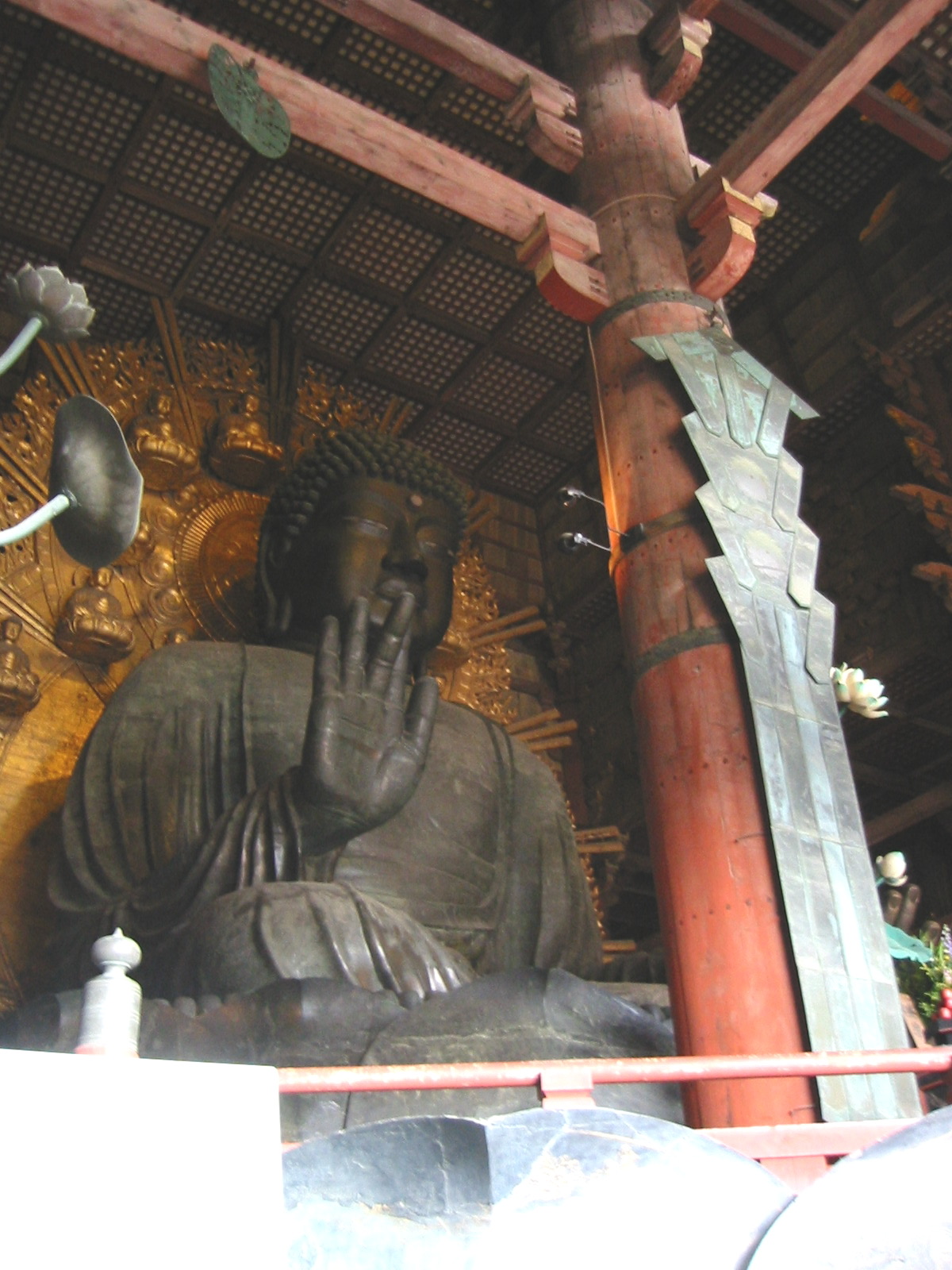
End with a monument that turned faith, material resources and political authority into a national project.Emperor Shomu promoted provincial monasteries and the colossal Vairocana Buddha during a period of epidemic and political strain. The 752 consecration gathered court, clergy and international connections in one ceremony. Look beyond scale: copper, labor, land and specialist knowledge reveal both the reach of the state and its reliance on temples and donors.
Open in Google Maps ↗BOOKING OPTIONS / AFFILIATE
Cover Kyoto and Nara in one day, or focus on Nara Park
The Klook option is a roughly ten-hour group tour from Osaka with English, Chinese and Korean packages. The Viator option is a roughly four-hour English-guided bus tour of Todai-ji, Kasuga Taisha and Mount Wakakusa. Neither includes this page’s Asuka route.QUESTIONS BEFORE THE TRIP
Before traveling from Asuka to Nara
Plan around two distinct areas, dispersed remains and visitor facilities with different schedules.01Can I visit all seven stops in one day?
No, not at a useful historical pace. Asuka and central Nara are separate travel areas, and the sites within Asuka are dispersed. Use one day for Asuka and Fujiwara Palace, then one day for the Nara Palace and temple route. If you have only one day, choose either the self-guided Nara section or a packaged tour with a narrower itinerary.
02Should I visit Asuka or Nara first?
Start with Asuka if you want to follow the historical sequence. The Asuka court’s adoption of Buddhism, diplomatic experiments and political reform lead into Fujiwara-kyo, the legal state and then Heijo-kyo. Reversing the days is possible if transport or opening schedules make it more practical.
03Can I walk between the three Asuka-area stops?
Do not plan on walking the full route. Asuka-dera and the palace remains can be combined with walking, a sightseeing loop bus or a rental bicycle, but Fujiwara Palace lies outside Asuka village. Check current bus and rail connections, and allow extra time when services are infrequent.
04Does one Nara bus pass cover the entire two-day route?
Not necessarily. Nara Kotsu offers several passes with different zones. The central Nara pass covers places such as Nara Park, the Nara Palace Site and Nishinokyo, while wider products include selected Asuka attractions. This route also uses rail and does not exactly match one pass area, so compare the latest coverage before buying.
05Are the temples and reconstructed palace buildings open every day?
Opening hours, last admission, exhibition access and closure days vary by facility and season. Outdoor ruins may remain accessible when an associated museum or reconstructed building is closed. Check each official page shortly before travel rather than relying on a fixed timetable in this guide.
06Does either tour follow this two-day ancient-history route?
No. The Klook option is an Osaka-departure highlights tour combining Kyoto and Nara in about ten hours. The Viator option is an English-guided bus tour focused on Todai-ji, Kasuga Taisha and Mount Wakakusa in about four hours. Neither covers the Asuka Palace, Fujiwara Palace, Nara Palace and all three temples in this guide.
BEFORE YOU GO