HISTORY WALK / EDO TOKYO
Walk the government city of the Tokugawa shoguns.
Connect the national roads, the administrative castle, urban welfare and the violence of the shogunate’s final years. Four stops place more than two centuries of government back into the distances of present-day Tokyo.
- Duration
- About 8 hours
- Transport
- Walk + subway
- Period
- 1600—1868
ROAD → CASTLE → CONSEQUENCE
Change the meaning of government at each stop.
NihonbashiNational movement
→2Edo CastlePolitical command
→3City sitesPolicy and conflict
ONE-DAY ROUTE
Four places, one political city
Short on time? Our half-day suggestion keeps Nihonbashi, the East Gardens and Sakuradamon, leaving Koishikawa for another day. For the full route, allow separate travel time north to Koishikawa and back to the palace area; the stops are not one continuous central-city walk. Check both garden calendars before choosing a date.
Nihonbashi and the Zero Milestone
Begin where roads turned the shogun’s city into a national network.The Tokugawa government designated Nihonbashi as the starting point of the Five Routes in the early seventeenth century. Daimyo processions, couriers, merchants and goods converged here, so sankin-kotai was not only a system of political control: it also shaped transport and consumption. The road marker visible today is modern, while the bridge preserves the logic of Edo’s official center.
Imperial Palace East Gardens and Edo Castle
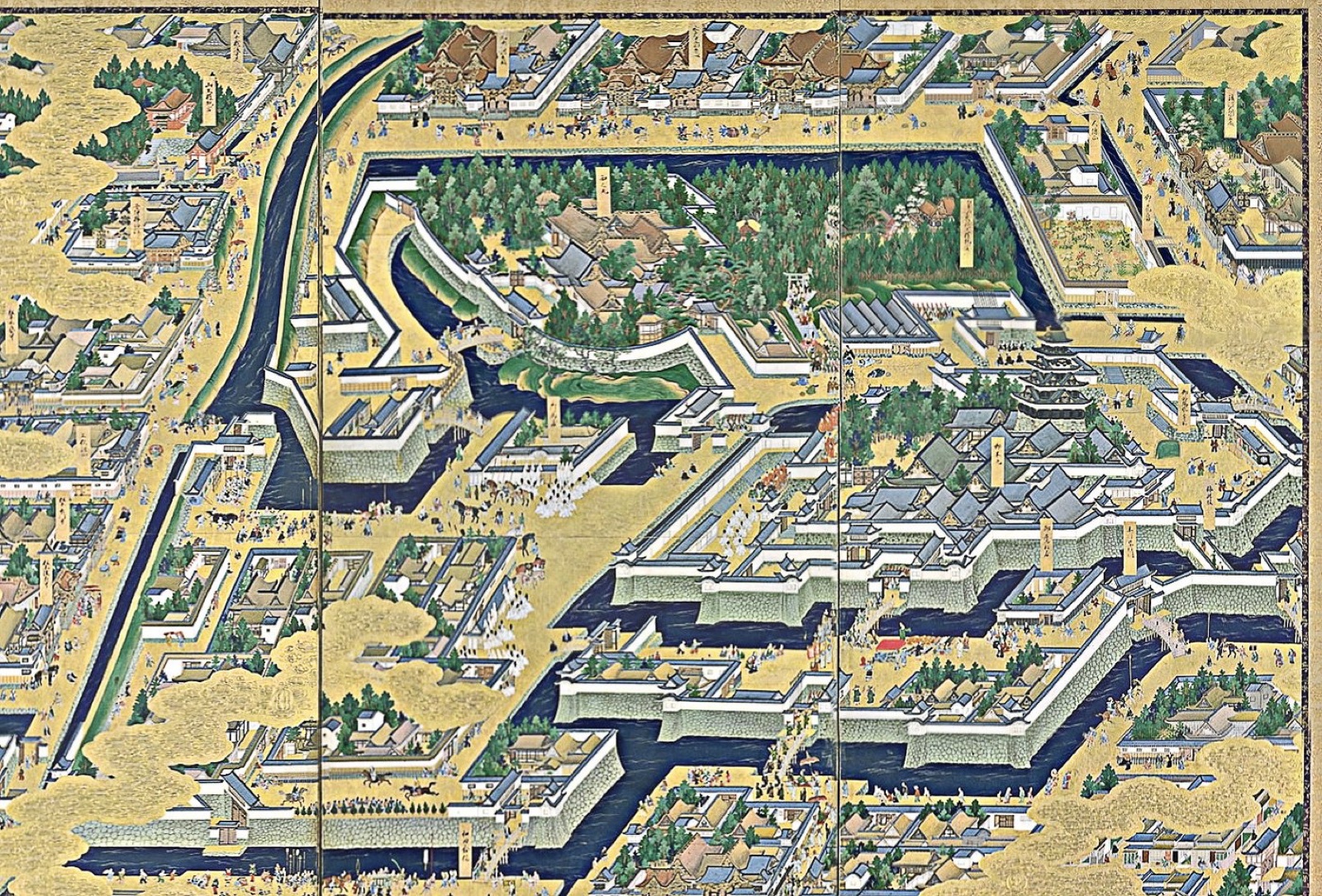
Read the shogun’s castle as a government, not only as a military stronghold.The East Gardens occupy former Honmaru, Ninomaru and Sannomaru areas of Edo Castle. Enter through Ote-mon and use the surviving gates, guardhouses, stone walls and keep foundation to reconstruct a hierarchy of access. The castle’s main buildings are gone, and the present Imperial Palace is a later institution, but the terrain still explains how the shogunate staged authority and administered the daimyo.
Koishikawa Botanical Garden and the former Yojosho
See Kyōhō reform through urban medicine rather than tax and frugality alone.The Koishikawa Yojosho opened in 1722 after an idea submitted through Shogun Tokugawa Yoshimune’s petition box. It treated poor townspeople and made public welfare part of the government’s response to a growing city. The site now lies within the University of Tokyo’s botanical garden, so the historical stop follows the garden’s admission rules and opening calendar.
Sakuradamon Gate and Kokyo Gaien
End where the pressures of treaty, succession and imperial politics became street violence.In 1860, Tairō Ii Naosuke was attacked outside Sakuradamon as his procession approached the castle from the Hikone domain residence. The gate’s defensive form survives, but the political system it protected was under severe strain. Walk the open space outside the gate to understand how close a domain procession came to the shogunate’s center—and how quickly that protection failed.
BOOKING OPTIONS / AFFILIATE
Travel farther by subway, or go deeper at Edo Castle
The Klook option covers Tokyo Metro and Toei Subway for 24, 48 or 72 hours. The Viator option is an approximately two-hour English walk through the Imperial Palace East Gardens and former Edo Castle. Neither includes this page’s entire route.QUESTIONS BEFORE THE TRIP
Before walking through Edo Tokyo
Plan around garden closures, ticket coverage and the difference between Edo Castle remains and the present Imperial Palace.01What is a shorter half-day Edo history route?
Our suggested shorter version connects Nihonbashi, the Imperial Palace East Gardens and Sakuradamon, omitting the northern detour to Koishikawa. Budget roughly four to five hours including transfers and breaks, depending on how much of the gardens you explore. This is a planning estimate. Check the East Gardens calendar first; an exterior walk on a closed day is not a substitute for seeing the castle remains inside.
02Do I have to book a tour to explore the East Gardens?
No. Entry is free on opening days, and the Imperial Household Agency provides a free audio-guide app. A paid walking tour is an optional choice for live explanation and questions, not an admission requirement. Check the official visitor page for the current calendar and app information. Neither a self-guided garden visit nor the tour listed here gives access inside the Imperial Palace buildings.
03Can I realistically visit all four stops in one day?
Yes, if you begin at Nihonbashi in the morning and keep the East Gardens and Koishikawa visits focused. Both gardens have closing days and last-entry times. If either is closed, turn the day into a shorter route through Nihonbashi, the castle’s outer landscape and Sakuradamon rather than rushing to substitute sites.
04Are the Imperial Palace East Gardens free, and do I need a reservation?
The East Gardens are free and normally do not require advance booking, but entry includes a baggage check. They are generally closed on Mondays and Fridays, with holiday exceptions and additional closures. Opening hours vary by season, so use the Imperial Household Agency calendar immediately before visiting.
05Is the present Imperial Palace the same building as Edo Castle?
No. The palace occupies much of the former castle grounds, and the East Gardens preserve parts of the Honmaru, Ninomaru and Sannomaru, but the shoguns’ main palace buildings no longer survive. Treat the walls, gates, guardhouses, moats and terrain as evidence of Edo Castle rather than assuming every present building is Tokugawa-period.
06Can I enter Koishikawa Botanical Garden for free?
No. It is a paid University of Tokyo facility with its own closure days and last admission. The garden is large, so allow extra time if you want to see more than the former Yojosho area. Check the official English visitor guide for the current calendar and admission details.
07Should I buy a Tokyo Subway Ticket or use an IC card?
The subway ticket covers all Tokyo Metro and Toei Subway lines for 24, 48 or 72 hours from first use, but not JR or other private railways. It works best when your wider Tokyo itinerary uses the covered subway networks repeatedly. For fewer journeys or mixed operators, compare the total with pay-as-you-go IC card fares.
08Does the guided tour follow this full one-day route or enter the palace?
No. The Viator product is an approximately two-hour English walking tour centered on the Imperial Palace East Gardens and former Edo Castle. It does not include Nihonbashi, Koishikawa or Sakuradamon as this guide schedules them, and it is not an interior tour of the Imperial Palace buildings.
BEFORE YOU GO
Check garden calendars and ticket conditions at the source
The East Gardens and Koishikawa Botanical Garden have different closure calendars and last-entry times. Tokyo Subway Ticket eligibility and redemption also vary by sales channel. Recheck official information shortly before travel.READ THE PEOPLE