BIOGRAPHY / EVIDENCE & LEGEND
Takeda Shingen
1521–1573 · Daimyo of Kai: warfare, law and river managementTakeda Shingen was a territorial lord, or daimyo, based in Kai, present-day Yamanashi Prefecture. His campaigns made him a formidable rival of Uesugi Kenshin and Tokugawa Ieyasu. But battles are only part of his history: laws and flood-control works also reveal the demands of governing a territory. He died in 1573 without becoming Japan’s national ruler.
What happened at Kawanakajima? ↓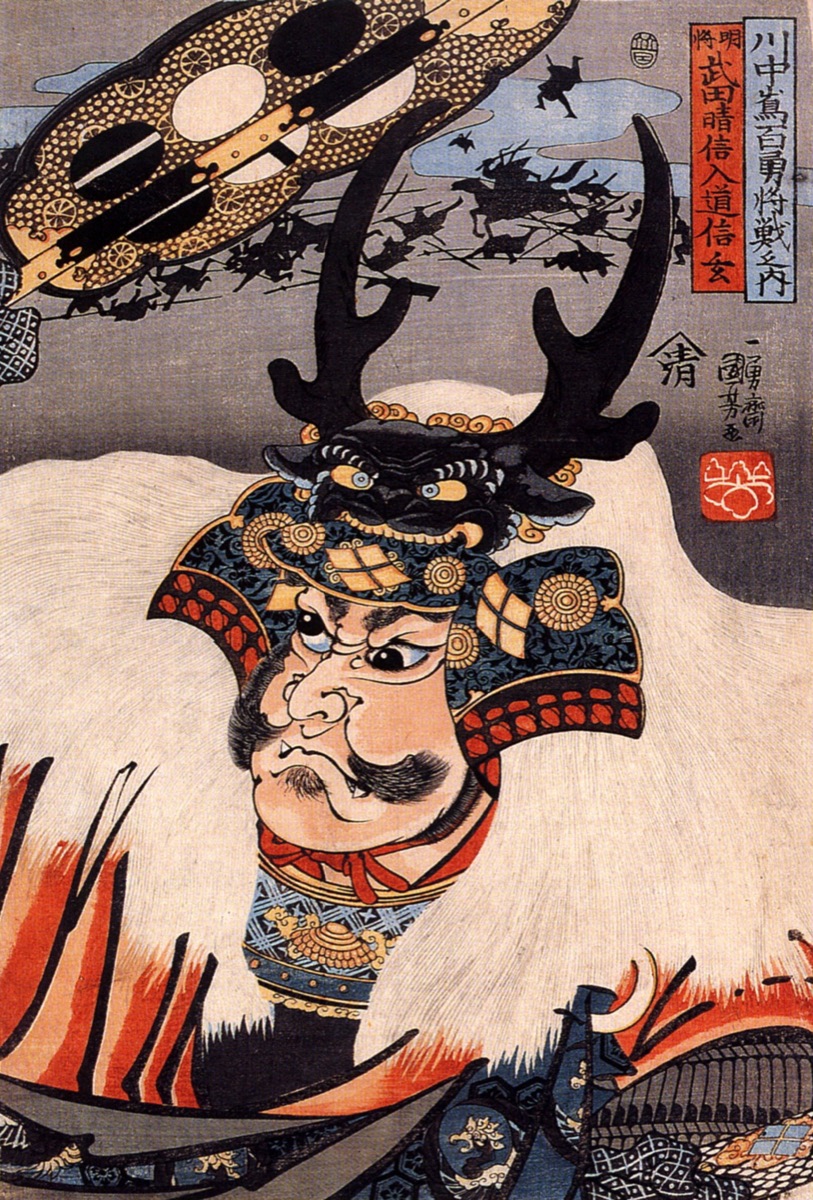
Shingen’s life at a glance
- 1521
Born into the Takeda family of Kai; also known as Harunobu.
- 1541
Took leadership after his father Nobutora was expelled from Kai.
- 1547
Issued the territorial law known as the Koshu Hatto.
- 1553–1564
The Kawanakajima campaigns brought the Takeda into repeated conflict with Uesugi Kenshin.
- 1560
Traditional completion date associated with the Shingen embankment; river works continued to be repaired later.
- 1561
The fourth Battle of Kawanakajima became the best-known encounter in the rivalry.
- 1572–1573
A western campaign brought victory over Ieyasu at Mikatagahara. Shingen died in 1573.
Who was Shingen, and where did he rule?
Shingen belonged to the Takeda family of Kai, an inland province west of the Tokyo region. His earlier name was Harunobu. He was a regional ruler in the Sengoku period, when competing military houses struggled over territory; he was not a shogun or an emperor.
Kofu’s development did not begin with Shingen alone. His father Nobutora established his base at Tsutsujigasaki in 1519. Shingen inherited a political centre already under construction, then took control in 1541 after his father’s expulsion. This family rupture is an important counterpoint to later images of an effortlessly united warrior house.
Ruling a province: the Koshu Hatto
The Koshu Hatto, issued in 1547, belongs to the territorial laws known as bunkokuho. These were rules established by a daimyo for his own domain, rather than a uniform legal code governing all Japan.
This distinction matters when reading Shingen’s career. Military success had to coexist with the continuing task of ordering affairs within his territory. Calling him a great commander does not, by itself, explain how the lands behind his army were governed. The law provides another route into that question.
Sources: [3]
Kawanakajima: a rivalry, not just one duel
The name Kawanakajima covers repeated encounters between Shingen and Uesugi Kenshin from 1553 to 1564. The fourth battle, in 1561, is especially associated with the area between the Chikuma and Sai rivers in present-day Nagano. Treating the whole rivalry as one afternoon loses its extended chronology.
A celebrated story has Kenshin strike at Shingen with a sword while Shingen defends himself with a war fan. Nagano City Museum discusses this through the Koyo Gunkan tradition and later monuments. A statue illustrating the story is evidence of its commemoration, not contemporary proof that the duel occurred exactly as depicted.
Shingen’s embankments: protecting the Kofu Basin
The Kamanashi and Midai rivers brought destructive flooding to the Kofu Basin. The works called Shingen Zutsumi are traditionally associated with Shingen’s response. Yamanashi’s official English guide describes a series of dikes said to have been built on his orders, preserving an important qualification about their origins.
Kai City explains a wider arrangement of stone works, embankments and natural terrain used to influence the force and direction of water. It also records subsequent repairs. The present landscape should therefore not be mistaken for a completely unchanged sixteenth-century construction, nor reduced to one heroic ruler building a single wall.
Mikatagahara: defeating the future shogun
During the campaign of 1572–1573, Shingen advanced into the region controlled by Tokugawa Ieyasu. The capture of Futamata Castle threatened Ieyasu’s position around Hamamatsu. At Mikatagahara, the Takeda defeated him and he withdrew to Hamamatsu Castle.
The battle is often listed under 1572, using the year of the traditional Japanese calendar; do not assume that an untranslated lunar date is a modern Gregorian date. More important than a calendar label is the political contrast: the man who later founded the Tokugawa shogunate had suffered a serious defeat. His eventual success was not inevitable.
Sources: [8]
His death and the warrior remembered later
Shingen died in 1573. His career ended before the eventual Tokugawa settlement, so imagining what he might have achieved had he lived longer remains a counterfactual, not a historical outcome.
Images need the same care as stories. The Kuniyoshi picture at the top of this page dates from the nineteenth century, long after Shingen’s death. It offers a later artist’s warrior image, not a record of his appearance made from life. Read it alongside documentary chronology and surviving places rather than as a substitute for them.
Where to explore Shingen’s history today
Start in Kofu with the former Takeda residence, now the site of Takeda Shrine, and the nearby Shingen Museum. The museum introduces the Takeda family and the development of the town. These places help reconnect a familiar warrior name with the provincial centre from which he governed.
Do not confuse that residence with Kofu Castle. Kofu City dates the castle’s construction to the period after the Takeda family’s fall, under Hideyoshi’s authority. Its remains belong to a later stage of the city’s history, not to Shingen’s own castle residence.
Kawanakajima Battlefield Park is in Nagano, a separate destination from Kofu. Its monuments are useful for exploring how the battles have been remembered. Consult the official local pages for current visiting arrangements; the historical connections described here are not a promise that every building or exhibition is always accessible.
COMMON QUESTIONS
Questions about Shingen
What is Takeda Shingen famous for?
He ruled Kai, fought Uesugi Kenshin at Kawanakajima and defeated Tokugawa Ieyasu at Mikatagahara. Territorial law and flood-control works are also important parts of his legacy.
Was Takeda Shingen a shogun?
No. He was a daimyo, a territorial lord. He did not become the head of Japan’s warrior government.
Did Shingen and Kenshin really fight a duel?
The sword-and-war-fan encounter is a famous tradition represented in later monuments. Those depictions do not establish that the episode happened exactly as told.
Was Kofu Castle Shingen’s home?
No. His base was the Takeda residence at Tsutsujigasaki, associated today with Takeda Shrine. Kofu Castle was built after the Takeda family’s fall.
Where can I learn about Shingen in Japan?
Kofu’s former Takeda residence and nearby Shingen Museum are a useful starting point. The river works in Kai and the Kawanakajima battlefield in Nagano offer different perspectives on his legacy.
SOURCES