BIOGRAPHY / EVIDENCE & LEGEND
Murasaki Shikibu
Late 10th–early 11th century; exact dates uncertain · Author of The Tale of Genji and a court diaryMurasaki Shikibu was a writer and lady-in-waiting in the imperial court of early eleventh-century Japan. She is known for The Tale of Genji and a diary describing court life. The novel’s world of relationships, status and loss has inspired readers and artists for centuries. She was a historical person; Hikaru Genji, the central figure of her tale, is a fictional character.
What is The Tale of Genji about? ↓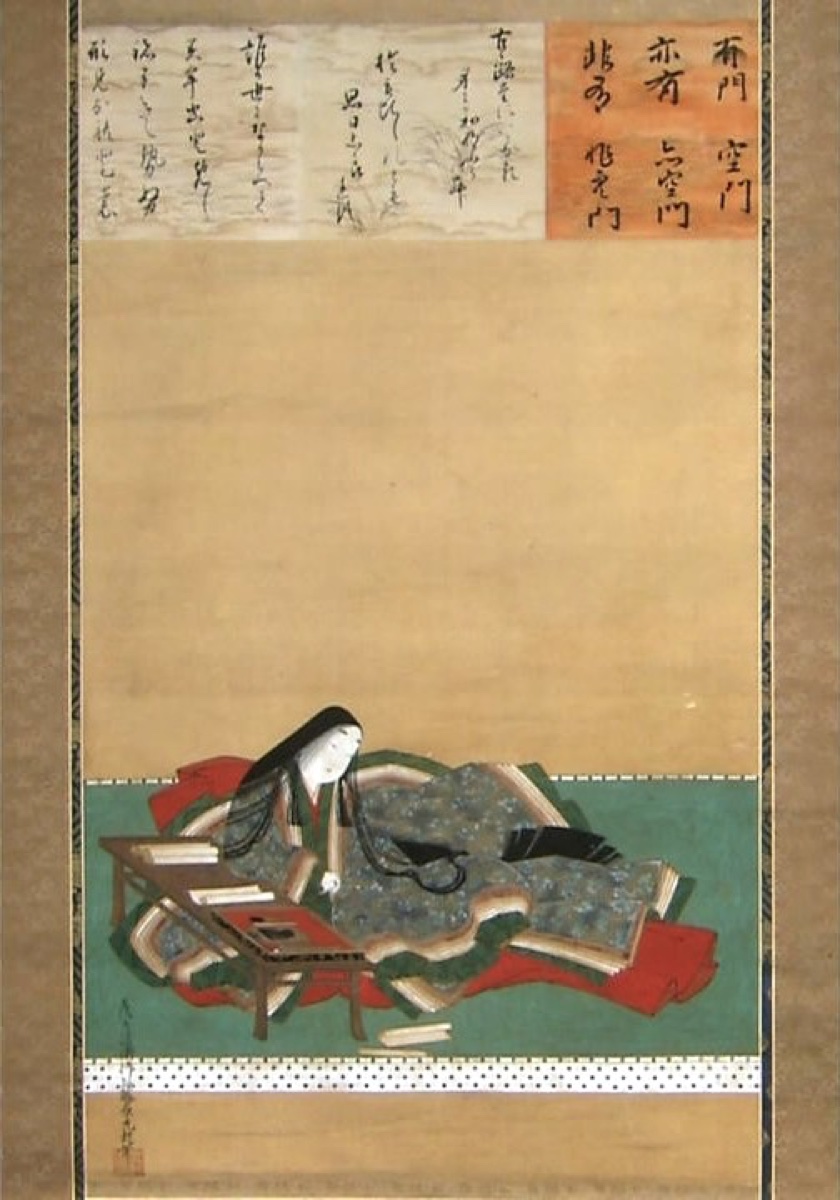
Murasaki Shikibu’s life at a glance
- Late 10th century
Her birth is generally placed in this period, but no exact birth and death dates are securely established.
- Early 11th century
Served Empress Shoshi, daughter of Fujiwara no Michinaga, at the court of Emperor Ichijo.
- 1008–1010
The surviving diary describes this period, including imperial births and court celebrations.
- Composition
The Tale of Genji took shape in the early eleventh century. A single precisely documented completion date should not be assumed.
- 13th century
Artists illustrated her diary long after the events it describes.
- Later centuries
Manuscripts, paintings and adaptations carried the tale to new readers.
Who was Murasaki Shikibu?
Murasaki Shikibu belonged to the world of the Heian imperial court, not the later world of samurai government. She served Shoshi, a consort of Emperor Ichijo and daughter of the powerful Fujiwara no Michinaga. A lady-in-waiting participated in an elite household where ceremony and relationships were politically significant.
Her life cannot be reconstructed with the precision of a modern biography. The Gotoh Museum explicitly gives her birth and death years as unknown. Approximate dates in reference works are aids to placing her in time, not securely documented birthdays. Her diary offers a firmer point of entry into the court she observed.
Sources: [1]
What is The Tale of Genji about?
The Tale of Genji, or Genji monogatari, is a long work of fiction conventionally divided into fifty-four chapters. Its central figure, Hikaru Genji, is an emperor’s son removed from the imperial line. His relationships unfold within a society shaped by rank and family position.
It is more than a sequence of romances: status, ambition, grief and the consequences of other people’s choices matter throughout. Readers should distinguish Murasaki Shikibu, the author, from the character Murasaki in the story. A fictional person sharing part of her name is not, by itself, evidence of autobiography.
Was it the world’s first novel?
The work is often introduced as the world’s first novel. The Metropolitan Museum uses the more qualified description of an early psychological novel in its exhibition overview. The label helps communicate the tale’s importance, but it should not be treated as an uncontested finishing position in a worldwide race.
What counts as a novel depends on the definition being used. A more useful starting question is what this work does: it sustains a complex fictional society and gives readers extended access to relationships and interior lives. Its literary achievement does not depend on dismissing every earlier narrative tradition.
Sources: [4]
The diary is not the novel
The Diary of Murasaki Shikibu concerns the court around her, including Shoshi’s imperial births and the accompanying celebrations in 1008–1010. It is distinct from The Tale of Genji. Reading them together can illuminate her social world, but does not turn the novel into a factual record of her private life.
The illustrated diary scrolls are another layer. The Gotoh Museum dates them to the early Kamakura period, roughly two and a half centuries after the diary’s events. An illustration can preserve a later understanding of the court without being a picture drawn by an eyewitness.
Sources: [1]
How did readers inherit the text?
Kyoto University’s digital archive offers a fifty-four-volume manuscript set of The Tale of Genji, with its own catalogue record and images. This is a concrete way to explore how a long work existed as books, rather than as the single modern paperback a reader may know.
Do not assume that a digitised manuscript is the author’s original handwriting. Check the record’s date, format and attribution. A manuscript witness, a printed edition, a modern translation and an adaptation serve different purposes. When choosing a reading edition, look for a clear account of whether it is complete, abridged or retold.
Sources: [3]
Did she write the tale at Ishiyamadera?
A famous tradition places the beginning of the tale at Ishiyamadera, inspired by moonlight over Lake Biwa. The Met explicitly presents this as a legend. It has a long artistic and religious afterlife, but should not become a precisely verified account of the moment of composition.
The same care applies to her portraits. The seventeenth-century painting used here belongs to the history of remembering Murasaki, centuries after her lifetime. It is not proof of her physical appearance. These later works are valuable evidence of her reputation, even when they cannot document the events of her life.
Sources: [2]
Kyoto and Uji: literary places, not proof of fictional events
Uji is especially associated with the final ten chapters, commonly called the Uji chapters. The municipal Tale of Genji Museum introduces the story through models, audiovisual displays and other interpretive exhibits. It is a place to explore a literary world, not a claim that the fictional characters really lived there.
For the wider capital, our Kyoto history guide covers the Imperial Palace, Nijo Castle and Honnoji across different periods. It is not a Genji itinerary and does not include Uji or Ishiyamadera. Use the official museum link below to plan Uji separately, and confirm current opening information before a visit.
Sources: [5]
COMMON QUESTIONS
Questions about Murasaki Shikibu
Who wrote The Tale of Genji?
Murasaki Shikibu, a writer serving at the early eleventh-century Japanese imperial court, is its author. She is distinct from the fictional character Murasaki in the tale.
Was Hikaru Genji a real person?
Hikaru Genji is a fictional character. Connections between fiction and court society do not establish a one-to-one identification with a historical person.
When did Murasaki Shikibu live?
She lived around the turn of the eleventh century. Her exact birth and death years are uncertain; her diary describes court events in 1008–1010.
Is The Tale of Genji the same as her diary?
No. The Tale of Genji is fiction, while her diary describes and reflects on the court around her. Later illustrated scrolls are separate objects created after her lifetime.
SOURCES