BIOGRAPHY / EVIDENCE & LEGEND
Miyamoto Musashi
c. 1584–1645 · Swordsman, strategist and artistMiyamoto Musashi was a Japanese swordsman, teacher of strategy and painter who lived through the transition from civil war to Tokugawa rule. He is associated with Niten Ichi-ryu and The Book of Five Rings. His writings, artwork and connections with the Hosokawa family establish a historical person behind the legend, but many details of his youthful duels remain uncertain.
Explore The Book of Five Rings ↓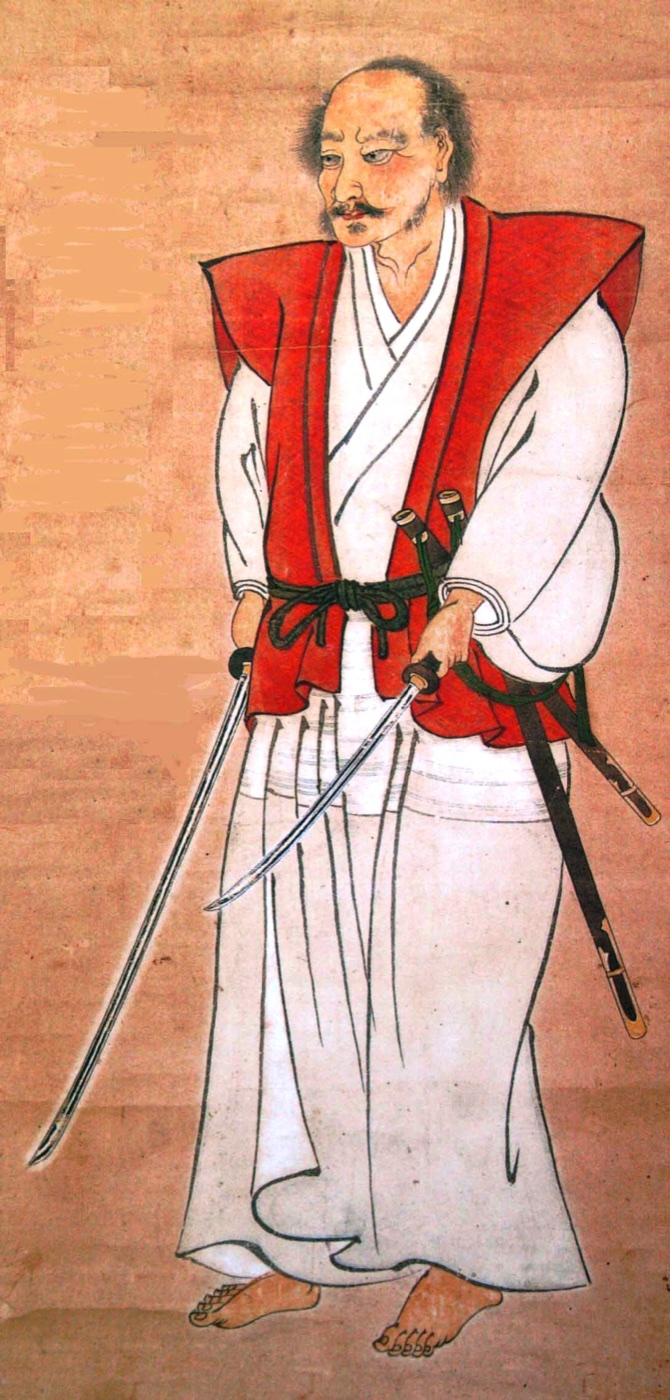
Musashi’s life at a glance
- c. 1584
Traditional birth year; his birthplace and early family history are debated.
- Youth
Later recalled winning numerous encounters. These are retrospective claims, not a complete independently verified match record.
- 1612 (traditional date)
The duel on Funashima, now Ganryujima, is conventionally placed in this year. Its familiar dramatic details are not equally secure.
- 1640
Invited to Kumamoto by the domain lord Hosokawa Tadatoshi.
- 1643–1645
Worked on The Book of Five Rings during his final years.
- 1645
Died in Kumamoto, leaving pupils, writings and paintings.
- 1654
His adopted son Iori erected the Kokura memorial inscription, an important early account of his career.
A swordsman in a changing Japan
Musashi’s lifetime bridged the late age of competing regional lords and the more settled order of the early Edo period. A daimyo was a territorial lord; the Tokugawa shogunate was the warrior government established in 1603. Musashi was not a shogun or a ruler of a large domain. His reputation rested on skill, teaching and the relationships through which that expertise was recognised.
His early life is much harder to document than popular fiction suggests. Different traditions place his birth in different locations, and later biographies fill gaps with vivid stories. Eiji Yoshikawa’s twentieth-century novel helped shape the familiar image of a wandering swordsman, but a novel’s convincing scenes are not independent evidence of what happened.
Sources: [4]
Musashi vs. Sasaki Kojiro: evidence and legend
The famous island encounter is associated with Funashima in the Kanmon Strait, between Honshu and Kyushu. The island is now known as Ganryujima. In 1654, nine years after Musashi’s death, his adopted son Miyamoto Iori erected a memorial at Tamukeyama in Kokura. Its account of Musashi’s career includes the island duel.
This is early evidence connected to Musashi’s family, but it is also a monument celebrating him, not a neutral eyewitness transcript. The basic encounter and the familiar scene of a deliberately late arrival, an angry opponent and a sword carved from a boat’s oar should not be treated as equally well established. Later storytelling gives those details a certainty the surviving evidence does not justify.
What is The Book of Five Rings about?
The Book of Five Rings, or Go Rin no Sho, presents Musashi’s approach to strategy in five parts: Earth, Water, Fire, Wind and Void. It moves from foundations and the handling of the body and sword to engagement, criticism of other approaches and the understanding developed through practice. It is a work about martial strategy, not originally a modern business manual.
The text gives an account of his own youthful victories. That makes it valuable evidence for how he described his experience, not proof that every reported encounter can be checked against another contemporary source. Readers should also distinguish a surviving copy or later edition from an original manuscript in Musashi’s own hand. The National Diet Library’s edition titled Gorin no sho: genpon was published in 1939; its title does not make the book a seventeenth-century autograph.
Did Musashi always fight with two swords?
Niten Ichi-ryu is strongly associated with using the long and short swords. This is why Musashi is often pictured holding a sword in each hand. The school’s identity, however, is not a record of the weapon combination used in every encounter of his life.
It is more useful to read his strategy as a discipline of observation, timing and effective use of available means than as one spectacular pose. Eisei Bunko’s discussion of his painting connects his writing on strategy with the idea that understanding one art can inform others. The swordsman and the artist are not separate inventions.
His final years: patrons, pupils and painting
In 1640, Hosokawa Tadatoshi invited Musashi to Kumamoto. Research announced by Kumamoto University in 2022 identified four documents illuminating his relationships there. They place him alongside scholars and people connected with tea culture, rather than in permanent isolation from society.
After Tadatoshi’s death, his successor Mitsunao continued to show concern for Musashi. A 1643 letter asks about his health and anticipates meeting him again. These records provide context for the years in which Musashi worked on The Book of Five Rings. He died in 1645.
His paintings offer another way to encounter him. Eisei Bunko holds a painting of Daruma attributed to Musashi, while the Shimada Museum preserves materials associated with his life and art. A portrait, a sword said to have belonged to him and a manuscript copy each carry different kinds of evidence; their labels matter as much as their visual appeal.
Where can you explore Musashi’s history today?
Tamukeyama Park in Kitakyushu is the place to approach Iori’s memorial inscription as a historical object. Kumamoto’s Shimada Museum is a starting point for his portrait and associated materials. Check the museum’s current exhibition information before visiting: a collection is not a promise that every original object is on display.
Kyoto’s Ichijoji Sagarimatsu is a site of memory associated with the Yoshioka encounters. Kyoto City’s own marker database notes doubts about identifying this precise location with the duel. Visiting a memorial can reveal how a story was remembered without proving every part of that story.
COMMON QUESTIONS
Questions about Musashi
Was Miyamoto Musashi a real person?
Yes. Documents about his later life, his writings and paintings, and his adopted son’s memorial distinguish the historical Musashi from the fictional versions. Uncertainty about youthful adventures does not mean he was invented.
Was Musashi really undefeated in sixty duels?
He described more than sixty youthful encounters without defeat. Treat this as his retrospective account, not an independently verified official record of every duel.
Did Musashi write The Book of Five Rings?
Yes. It is his work on strategy, organised into Earth, Water, Fire, Wind and Void. Surviving manuscript copies and later printed editions must be distinguished from an original in his own hand.
Is the portrait a proven self-portrait?
No. The image is traditionally described as a self-portrait, but that attribution is uncertain. The Shimada Museum identifies the painter of its Musashi portrait as unknown.
SOURCES